Plain Money Get the Manual

The Amish Way to a Smaller Bill

Your house is leaking money.

131 practical ways to find it and stop it — each with its cost, its payback, and its proof. 346 pages. First edition, 2026.

Get the Manual

One-time payment · Digital PDF · No subscription

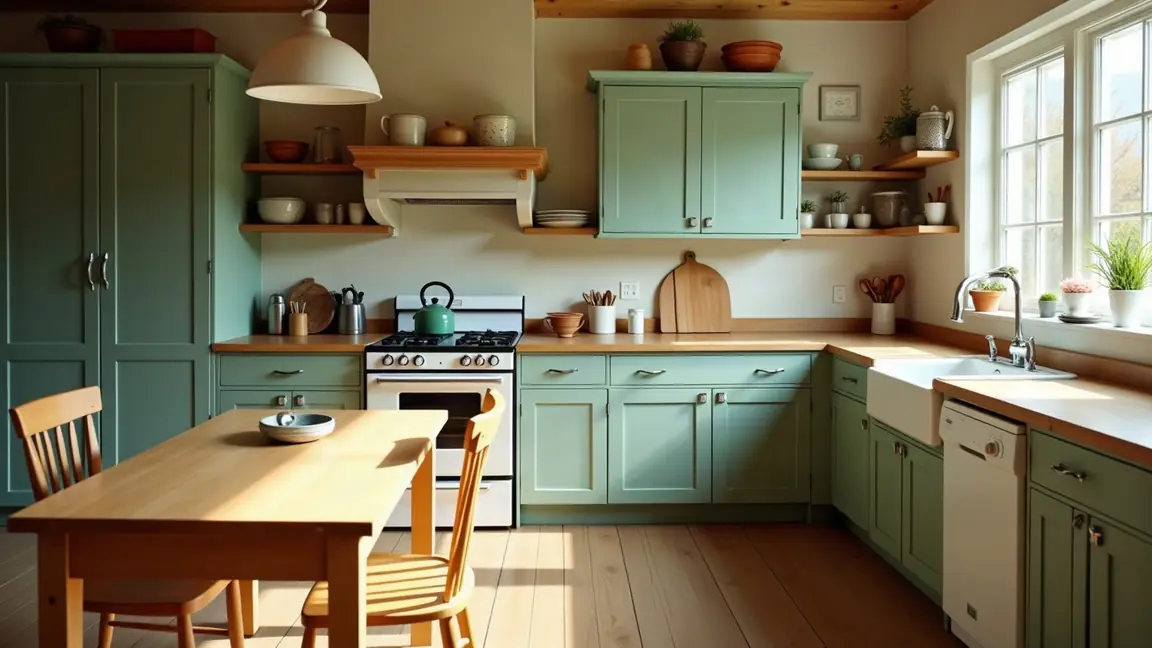
A plain, well-kept American farmhouse kitchen in early morning light.
The Amish Home Savings Manual by Amos Miller — the Plain Money cover.

What the book's own worked examples find

Three ordinary things, three real numbers.

$47–118The standby sweep a year, for one free evening with a watt meter
$150One running toilet a year, ended by a $10 part
$900Forgotten subscriptions a year, found in one hour of statements

Illustrative examples from the book, at its own stated assumptions — not a promise about your home. Your rates and habits will give a different answer, which is why the book asks you to measure your own.

The problem

Nobody notices the small ones.

A household knows its rent to the dollar. Very few can come within $500 of what they spent on electricity last year.

That gap is where the money goes — a dozen small costs, each too minor to argue about, all repeating every month.

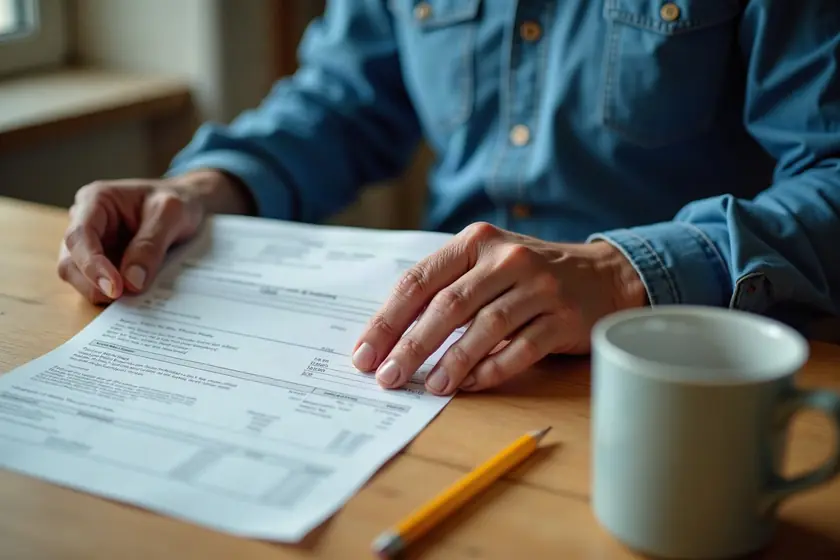
A person's hands holding an opened utility bill over a kitchen table.
  • Standby powerDevices that are "off" still draw current — 5–10% of a home's electricity, nationally.
  • Lights still on the old currentThe basement, the garage, the porch light burning twelve hours a night.
  • A running toiletThe most expensive fixture in the house when it fails. And it fails silently.
  • Water you heat and don't useMost tanks leave the factory near 140 °F. The DOE recommends 120 °F.
  • DraughtsOne worn exterior door is a small window left permanently open.
  • SubscriptionsBuilt to be invisible after signup. No reminder, ever.

What makes this different

Not 131 tips. 131 decisions.

Before you read a word of a method, you already know these eight things.

CostIn dollars
TimeMinutes or a weekend
DifficultyPlain language
SafetyLevel 1 to 4
Annual savingA range, assumptions shown
PaybackHow long to pay for itself
Renter or ownerBefore you start
ClimateHot, cold, all, humid

Then the method itself

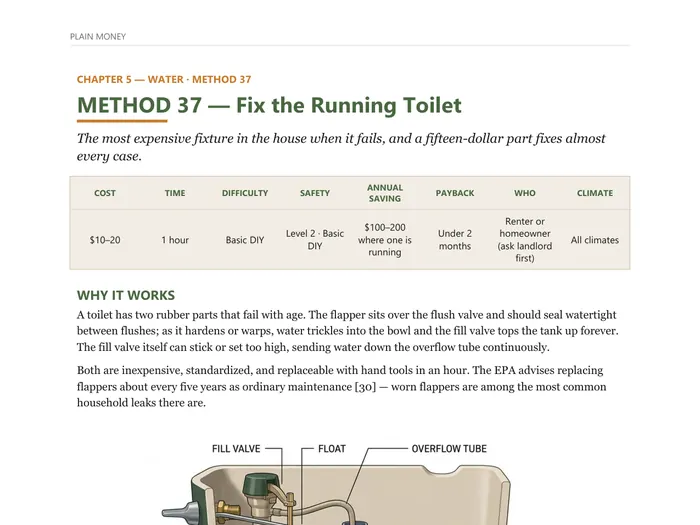
Why it works, what you need and what it costs, the steps, the formula with its assumptions — then Watch Out, where the limits and hazards live, and Evidence, which points to the source list at the back.

Every factual claim traces to a published source. Seventy-nine of them — the EPA, the Department of Energy, USDA, CDC, the Consumer Product Safety Commission.

The top of a method page from Plain Money, showing the At a Glance table of cost, time, difficulty, safety, saving, payback, suitability and climate.
The top of one method page. All 131 are built this way.

Start here

Measure first. Fix second.

You don't start with 131 methods. You start with an hour and your own bills.

The Household Savings Audit at the front of the book takes nine spending categories, eleven questions about your house, and the three rates you actually pay — then tells you which two chapters to open first.

A household spending $2,400 on cooling and $500 on water shouldn't start with the water chapter. After the audit, it won't.

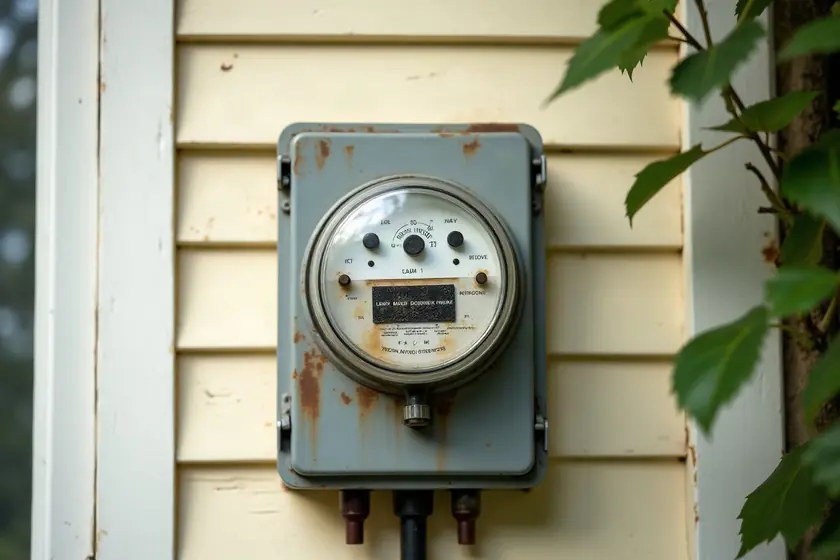
A residential electricity meter mounted on the clapboard wall of an American house.

One hour with your bills, and this book reorders itself around your house.

What's inside

16 chapters. Every place a household spends.

1 · Start HereFind your own numbers · 5
2 · ElectricityStandby, lighting, cold storage · 12
3 · CoolingFans, shade, AC care · 7
4 · HeatingLeaks, sealing, setbacks · 11
5 · WaterToilets, aerators, tanks · 8
6 · KitchenCooking and cold storage · 8
7 · PantryRotation, bulk, freezing · 9
8 · LaundryCold washing, drying · 6
9 · CleaningFour substances, safely · 7
10 · MaintenanceThe calendar, gutters, damp · 13
11 · GardenCompost, mulch, seed · 8
12 · PestsSeal, starve, bait · 7
13 · Buying SmarterTrue cost, subscriptions · 9
14 · Waste & ReuseRepair kit, food scraps · 6
15 · ResilienceOutages, water, papers · 7
16 · Big InvestmentsInsulation, heat pumps, solar · 8
  • 112of the 131 methods work whether you rent or own.
  • 125are Safety Level 1 or 2 — ordinary household work. Only three need a professional.
  • 53cost nothing at all to carry out. 114 cost under $25 to start.

Worked examples

Three methods, with the arithmetic attached.

These are the book's own worked examples, at its own stated assumptions. Illustrative calculations, not predictions — which is why the book asks you to measure your own before-and-after.
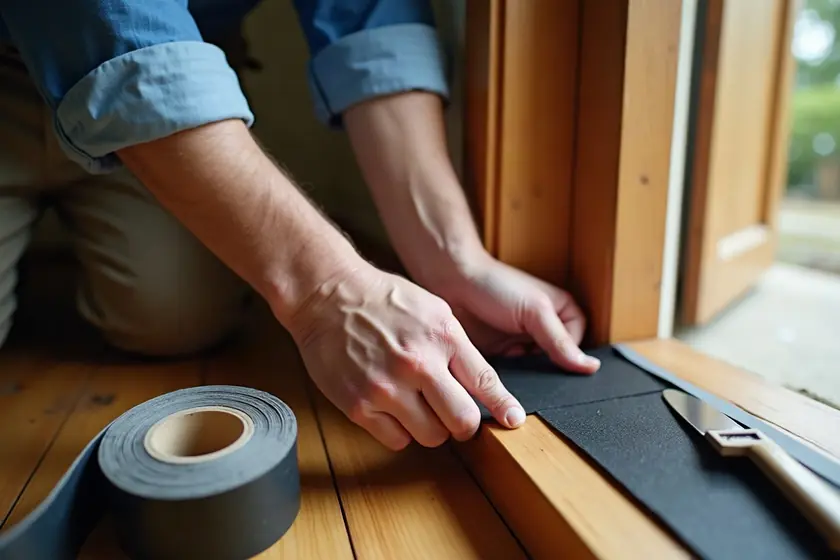
Hands pressing adhesive foam weatherstripping onto a door jamb.
Method 06 · StandbyCost $0

Stop paying for standby

One evening with a watt meter. A household removes 45 W it can honestly unplug — a spare TV and console, a printer, three chargers. That's 394 kWh a year.

$47 · $67 · $118 a year at low, medium and high electricity prices. Nothing was bought.

Hands with a household bill and a pencil on a kitchen table.
Method 108 · SubscriptionsCost $0

One hour of statements

Three streaming services at $14, an unused cloud tier at $10, a lapsed fitness app at $12, a duplicated music service at $11.

$75 a month — $900 a year Cancelling half of it saves $450.

Laundry drying on a rope clothesline in a backyard at golden hour.
Method 61 · LaundryCost $0

Wash cold by default

About 90% of a washer's energy goes into heating water. Modern detergents are built for cold. A household running 300 loads a year switches from warm.

$26 – $60 a year More on an electric water heater at a higher tariff.

Get the Manual

One-time payment · Digital PDF

If you don't know where to start

Four weekends. Mostly free.

A 30-Day Challenge is built into the front of the book. Every method in it is Level 1 or 2, and all but three cost under $25.

Weekend 1MeasureRead your meters. Find your rate. Sweep the standby. Meter your top ten appliances.
Weekend 2Water & laundryThe dye test. Fit aerators. Water heater to 120 °F. Switch to cold washing.
Weekend 3Heating & coolingFind the leaks. Weatherstrip the doors. Set the thermostat. Change the filter.
Weekend 4Kitchen & buyingSet the cold-storage temperatures. Cook a double batch. Sweep the subscriptions.

“One month is a short measurement window, and weather affects heating and cooling far more than habits do. Compare like with like — this January against last January.”

— the book's own caution, at the end of the challenge
Amos Miller, author of Plain Money, seated at a kitchen table.

A note from the author

I did not set out to write a long book. I set out to write one that could be checked.

Most household advice is a sentence long, and never tells you what it costs, whether it is safe, or what it is worth in a house like yours. So I wrote every method the same way — and checked every claim against a published source.

Where the evidence did not support a popular claim, I said so: about homemade laundry soap, about the powders sold as killing every insect, and about replacement windows sold as an energy investment.

Amos MillerAuthor, Plain Money · First Edition, 2026

Why this is credible

The whole book is built to be checked.

79 numbered sources

Cited inline and listed in full — the EPA, ENERGY STAR, the Department of Energy, the EIA, USDA, FDA, CDC, CPSC, FTC, NFPA, Lawrence Berkeley National Laboratory, NREL and university extension services.

Every calculation shows its assumptions

Most are shown at three energy prices rather than one, because US rates vary by more than three to one across the country.

A safety level on all 131 methods

Level 4 means professional work — the book explains the decision and the economics, and deliberately does not tell you how to do the job. Electrical, gas, refrigerant, structural and roof work go to licensed trades.

“Replacement windows are among the worst-paying energy upgrades sold.”

That is how Method 129 opens. It then gives a five-step ladder that captures most of the benefit for about $60 a window instead of $500–1,500. A book that argues you out of a $10,000 purchase is not trying to sell you something.

Sources cited, not endorsements. These organizations are named to identify published sources of factual information and have not reviewed or endorsed this book.

The complete manual

Plain Money

The Amish Way to a Smaller Bill · First Edition, 2026

  • 131 methods, each with cost, time, difficulty, safety level, saving, payback, suitability and climate
  • 16 chapters — electricity, heating, cooling, water, kitchen, pantry, laundry, cleaning, maintenance, garden, pests, buying, waste, resilience, investments
  • 346 pages, illustrated with 150 diagrams and photographs
  • The Household Savings Audit — one hour that reorders the book around your house
  • The 30-Day Challenge — four weekends of mostly free methods
  • The Savings Tracker and Annual Household Audit, to measure what actually changed
  • Method Index, glossary, maintenance calendar, seasonal checklist and tools list
  • 79 researched sources, cited method by method
Regular price $147 $47 Save $100
Get the Manual — $47

One-time payment · No subscription, no recurring charge
Digital PDF — phone, tablet, computer, or printed at the kitchen table
Digital download — all sales are final

Questions

Before you decide

Does it work if I rent?

Yes, for most of it. 112 of the 131 methods are marked as working for renters or owners, and every method carries a marker so you know before you start. The 19 owner-only methods are the permanent ones — attic insulation, ducts, grading, roof work.

I'm not handy. Is it still useful?

125 of the 131 methods are Safety Level 1 or 2 — ordinary household work with ordinary precautions. Three need experienced DIY skills. Three are professional-only, and there the book explains the decision and the economics rather than the procedure.

Are the savings guaranteed?

Every dollar figure is either a cited figure from a published source or an illustrative calculation with its assumptions shown — and it is always labelled which. Buildings, appliances, climates and utility rates vary enormously, so the book asks you to measure your own before-and-after rather than rely on its ranges, and includes a Savings Tracker for exactly that.

Will all 131 methods apply to my home?

No — and the book says so. That is why it opens with the Household Savings Audit, which cuts 131 down to the ten or so worth your time, based on what you spend and what your home is.

Is this book only for Amish households?

No. It is a household savings manual written in the plain, practical register of traditional North American home-keeping — not a guide to Amish life, and it does not ask you to change how you live. The book states plainly that it is independent and not affiliated with, endorsed by or sponsored by any Amish community, organization or church district.

What exactly do I receive, and how?

The complete 346-page manual as a digital PDF — all 131 methods, all 16 chapters, the Household Savings Audit, the 30-Day Challenge, the Savings Tracker, the tools checklist, the maintenance calendar, the Method Index, the glossary and the full 79-source reference list. Your purchase is handled by Payhip, and the PDF is delivered as a download after payment.

Can I read it on my phone?

Yes. It is a standard PDF and reads on a phone, tablet, laptop or e-reader. In the screen edition every contents line and cross-reference is a live link. You can print any page — the audit, the challenge and the tracker are designed to be filled in by hand.

Are the methods safe?

Every method carries a safety level from 1 to 4 and a "Watch Out" section covering hazards, limits and common mistakes. The book does not provide instructions for regulated or hazardous work: electrical work beyond plugging in listed devices, any gas work, refrigerant handling, structural alteration, regulated plumbing and roof work all go to licensed professionals.

Does it work in different climates?

Yes. Every method carries a climate marker — hot, cold, all climates, or humidity-dependent — and the audit asks about your climate so it can tell you whether to start with heating or cooling.

Can I get a refund?

No — Plain Money is a digital download, so the whole manual reaches you the moment you pay and all sales are final. That is why the page shows you so much before you buy: the chapter list, the method structure, worked examples and real pages from inside.

If the file will not download, or you are charged twice, email us and we will fix it. Full details are in the refund policy.

Is this financial advice?

No. Plain Money contains no financial, investment or tax advice, and no medical or health advice of any kind. It is general household information about reducing running costs.

One last thing

You worked for that money once already.

Small costs survive because each one looks too small to bother with. A few watts. A few gallons. Eleven dollars a month for something nobody has opened since March.

Plain Money is a way of looking — and 131 methods with enough information attached that you can tell which ones are worth your Saturday.

Regular price $147 $47 Save $100
Get the Manual — $47

One-time payment · Digital PDF · No subscription